

Read the author guidelines, then send your manuscript online.
Submit manuscript Author guidelinesOpen access journal · MJPJLJ
A scholarly venue for legal research on contemporary issues.
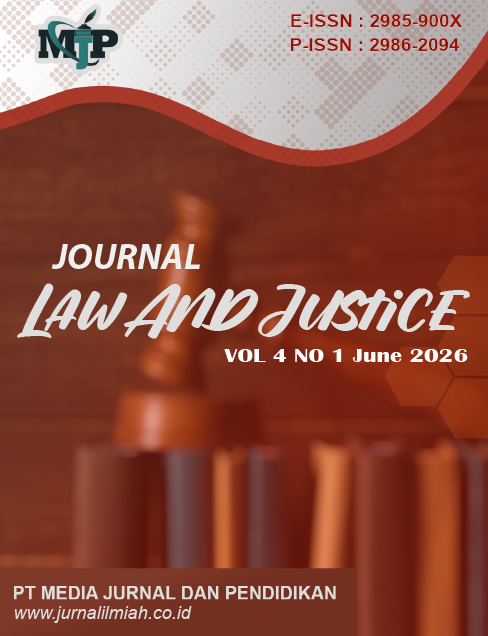 Vol. 4 No. 1 (2026)

Issue information
Authors' countries
This study analyzes the legal qualification and criminal liability in a case involving the misuse of the East Meyambanga Village Budget (APBDes), South Bolaang Mongondow Regency. The analysis focuses on distinguishing the elements of Article 2(1) and Article 3 of the Anti-Corruption Law, proving state financial loss, and formulating preventive measures derived from weaknesses in case governance. This study employed normative legal research using statutory, conceptual, and limited case approaches. The case materials were derived from publicly available information concerning the misuse of the APBDes for the 2018 and 2020 fiscal years, Detention Order No. PRINT-01/P.1.12.8/Fd.1/07/2025, the audit findings of the Inspectorate of South Bolaang Mongondow Regency amounting to Rp373.423.000,00, and trial progress reports. The findings indicate that Article 2(1) and Article 3 have different elemental structures. Article 2 requires proof of an unlawful act and conduct intended to enrich oneself, another person, or a corporation, whereas Article 3 emphasizes abuse of authority inherent in office for the purpose of benefiting oneself, another person, or a corporation. In cases involving village officials, Article 3 is more specific where authority over village financial management constitutes the principal means of committing the act; however, its application remains dependent on proof of actual loss, culpability, and a causal nexus. Prevention should focus on the segregation of functions, risk-based audits, APBDes transparency, strengthening the Village Consultative Body (BPD) and the community, and maintaining digital transaction trails.
The misuse of subsidized fuel and/or fuel whose supply and distribution are assigned by the Government disrupts the targeting accuracy of energy policies and access for eligible consumers. This study analyzes the effectiveness of investigators’ role at Pohuwato Resort Police (Polres Pohuwato) in enforcement action against fuel misuse and the evidentiary obstacles involved. The study employed an empirical legal research method using a socio-legal approach and qualitative analysis. The primary data were derived from interviews with the Head of the Special Crimes Unit (Kanit Tipidter) at Pohuwato Resort Police (Polres Pohuwato), four police reports from January–February 2026, field observations, and legal materials. Effectiveness was operationalized across procedural, repressive, preventive, and coordinative dimensions and then mapped against legal factors, law-enforcement factors, facilities, societal factors, and legal culture. The findings indicate partial effectiveness. Procedural responses and coordination have been implemented, as reflected in the four reports that reached the investigation stage; however, final repressive outcomes cannot yet be measured because the available materials do not contain information concerning P-21, case transfer, or judgments. The preventive effect has likewise not been optimal, as patterns of repeated purchases and modification of distribution equipment continue to be found. The principal obstacles concern support for legal metrology verification, laboratories, external experts, storage of liquid physical evidence, and technical coordination. Strengthening case handling should therefore focus on measurable investigation performance indicators, integration of recommendation letter data, technical support for proof, and cross-agency oversight of distribution.
Narcotics abuse involving children presents complex legal issues because children occupy a dual position as perpetrators of criminal offenses and as persons requiring protection and recovery. This study aims to analyze the legal status of children in narcotics abuse cases and the implementation of diversion at the investigation stage at the Pohuwato Resort Police under Law No. 11 of 2012 on the Juvenile Criminal Justice System (UU SPPA). The study employed an empirical legal research method using a juridical-sociological and qualitative approach. Primary data were obtained through institutional interviews with investigators from Satresnarkoba and Unit PPA in April 2026, while secondary data encompassed legislation, literature, and summaries of child cases from 2020–2024. Validation was conducted by comparing interview accounts, case-data summaries, and legal materials. Of 27 child cases from 2020–2024, 16 diversions were successful and 11 were unsuccessful. Qualitatively, successful diversion was associated with fulfillment of the requirements under Article 7 of the UU SPPA, family support, recommendations from Bapas, and the availability of recovery options, whereas unsuccessful diversion was associated with statutory provisions prescribing severe penalties, limited rehabilitation, and weak community support. This study confirms that investigators serve as gatekeepers, but legal classification must be based on facts and evidence rather than solely on creating an opportunity for diversion. Strengthening the documentation of the reasons for diversion outcomes and child rehabilitation networks is necessary to make recovery more measurable.
This article examines the status of marital property following the death of the husband in a marriage that was initially solemnized under Islam but subsequently became an interfaith marriage because the husband reverted to Christianity while the wife remained Muslim. There was no record of divorce or a court judgment terminating the marriage before the husband's death. Following the death of the husband, the child who followed the father's religion took control of the property, while the wife received no share of the property acquired during the marriage. This study employed a normative legal research method using statutory, conceptual, and case approaches. The case was treated as a case construction based on the chronology in the source manuscript and the available supporting records, rather than as a published court judgment. The findings indicate that a change of religion does not automatically terminate a marriage. In the absence of divorce or a court judgment, property acquired until the termination of marriage upon death remains presumed to be marital property. The wife's share must be separated before the distribution of the inheritance, whereas the estate includes only the husband's share of the marital property and his separate property. The inheritance regime is determined by the husband's religious status at the time of death, but religious differences do not extinguish the wife's proprietary rights in marital property. Legal protection may be pursued through an action for the determination and division of marital property, proof of the origin of the property, preservation of the disputed property, and enforcement of the judgment.
Establishing the minimum age of marriage at 19 years through Law No. 16 of 2019 has not eliminated applications for a marriage dispensation, requiring judges to assess the tension between highly urgent grounds and the best interests of the child. This study analyzes the parameters of judicial consideration at the Marisa Religious Court and compares their application in Court Determination No. 177/Pdt.P/2025/PA.Msa, which was granted, and Court Determination No. 189/Pdt.P/2025/PA.Msa, which was denied. The study employed a socio-legal empirical method with a comparative case study design. Data were obtained through examination of court determinations, legislation, case data from 2019–2025, literature, and interviews with judges and were subsequently analyzed using a case matrix, thematic categorization, and source triangulation. The findings indicate that judicial considerations comprise legal-procedural dimensions; highly urgent grounds and evidentiary proof; the child's consent; education and psychosocial factors; reproductive health; economic responsibility; social context; and spirituality. The granted case was based on a combination of pregnancy, school dropout status, the parties' relative preparedness, and an assessment of lesser harm. The denied case demonstrated that biological preparedness and reproductive health requirements had not been met; the prospective husband's spiritual aspects were understood as supporting considerations rather than independent legal requirements. The novelty of this study lies in its comparison of two court determination outcomes from the same court and year, its reconstruction of a hierarchy of determinative grounds, and its formulation of a multidimensional assessment matrix. The findings are contextual and affirm that applications for a marriage dispensation must be examined rigorously and transparently, with due regard to the best interests of the child.



Open access, peer reviewed, with DOI for every article.


PT Media Jurnal dan Pendidikan
PT MEDIA JURNAL DAN PENDIDIKAN
Email : [email protected]
Address : Desa Pohuwato, Dusun Binakarya, Kec Marisa, Kab. Pohuwato, Gorontalo

This work is licensed under a Creative Commons Attribution-NonCommercial-ShareAlike 4.0 International License.