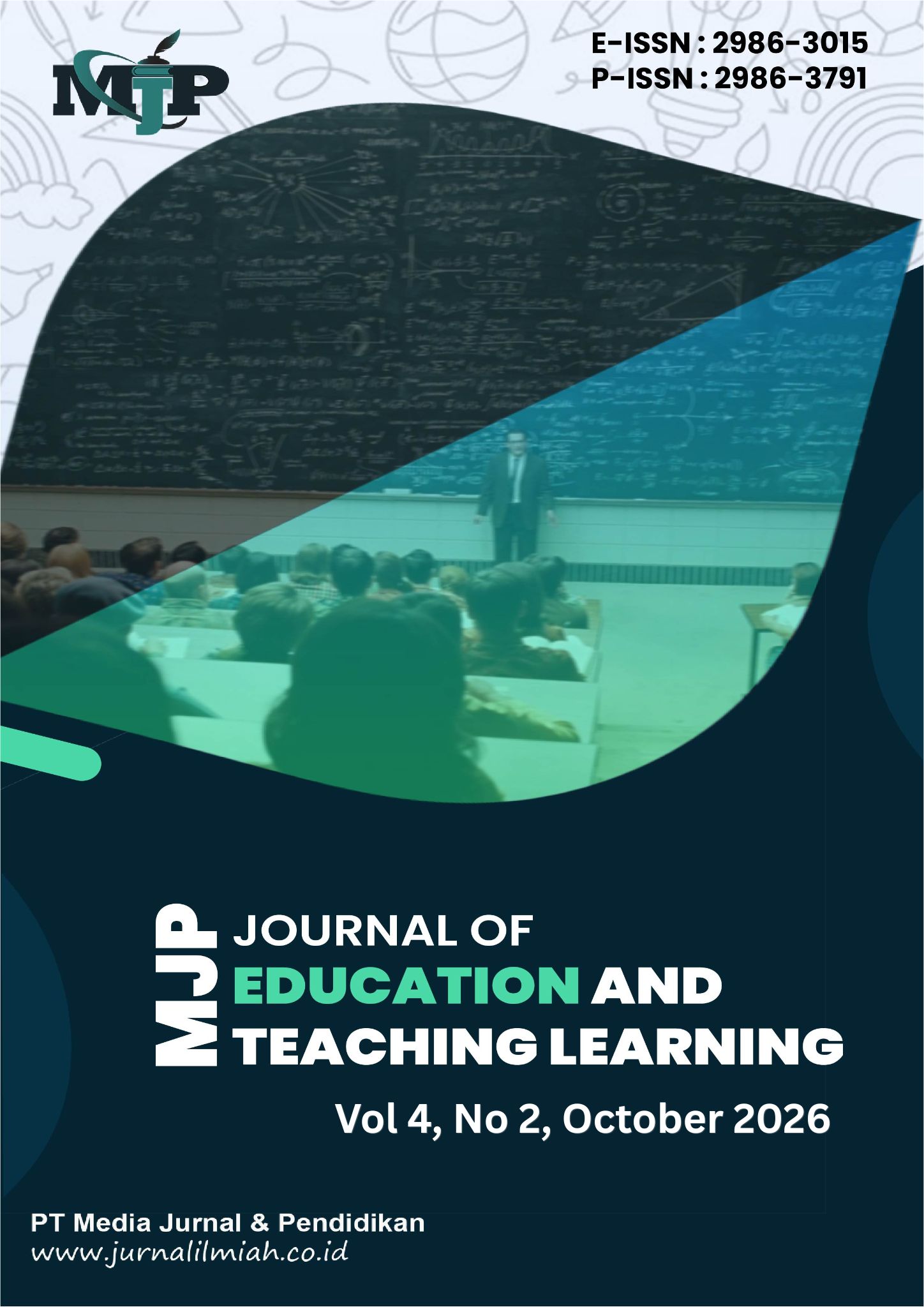
The effect of visual, auditory, and kinesthetic (VAK) learning models on PPKn learning outcomes in elementary schools
DOI:
https://doi.org/10.59211/mjpjetl.v4i2.424Keywords:
VAK learning model, learning outcomes, Civics education, elementary school, learning stylesAbstract
Learning outcomes of fourth-grade students in Civics education (PPKn) at SD Negeri 1 Watubelah were still below the minimum mastery criterion, largely because instruction remained teacher-centered and did not accommodate students' varied learning styles. This study examined the effect of the Visual, Auditory, Kinesthetic (VAK) learning model on the learning outcomes of fourth-grade students in the topic of Indonesia's cultural diversity. A quantitative quasi-experimental design with a nonequivalent control group was used, involving 33 students in the experimental class (IV B) and 36 in the control class (IV A), selected through cluster sampling. Data were collected through a 15-item multiple-choice test (Cronbach's Alpha = 0.892) and observation sheets, then analyzed using the Shapiro-Wilk normality test, Levene's homogeneity test, an independent-samples t-test, and the N-Gain test. The results showed the average posttest score of the experimental class (85.55) was higher than that of the control class (71.03), with a significant difference (t = 11.573; Sig. = 0.000 < 0.05), so H0 was rejected. The average N-Gain of the experimental class (69.35%) fell into the "fairly effective" category, while the control class (36.69%) fell into the "ineffective" category. It is concluded that the VAK learning model has a significant positive effect on students' PPKn learning outcomes.
Downloads
References
[1] P.R. Amruddin, et al., Quantitative Research Methodology, 2022.
[2] J. Archambault, The Effect of Developing Kinematics Concepts Graphically Before Introducing Algebraic Problem-Solving Techniques, Action Research, Arizona State University, 2008.
[3] Elisa et al., The effect of the VAK (Visual, Auditory, Kinesthetic) learning model on the science learning outcomes of grade IV students of SD Negeri 147 Pekanbaru, 2019.
[4] A. Firmansyah, D. Setiana, F. Fikriyah, Analysis of improving student literacy using Let's Read Asia media at SDN Pasirayu, ULIL ALBAB: Multidisciplinary Scientific Journal, 2024.
[5] R.R. Hake, Analyzing Change/Gain Scores, AREA-D American Education Research Association's Division D, 1999.
[6] Y. Handayani, Sukari, Problematics of the education system in Indonesia, JUPENDIS: Journal of Education and Social Sciences 3 (1) (2025) 168-179.
[7] R. Janah, K. Nurachadijat, Auditory and kinesthetic visual learning models in Qur'an lessons, Journal of Innovation, Evaluation, and Learning Development (JIEPP) 3 (2) (2023) 75-80.
[8] M. Maksudi, W. Triono, Web-based mapping geographic information system for high school/vocational schools in Kuningan Regency, REMIK: Research and E-Journal of Computer Informatics Management 9 (2) (2025) 712-722.
[9] M.F. Maulani, The Influence of the VAK (Visual, Auditory, Kinesthetic) learning model on the motivation of students of Harapan Mekar Medan Marelan Private Junior High School T.P. 2017/2018, Thesis, University of Muhammadiyah North Sumatra, 2018.
[10] Rahmah, VAK learning model in learning, 2024.
[11] D. Satria, I.H. Kusasih, G. Gusmaneli, Analysis of the low quality of education in Indonesia today: A literature review, Journal of Bintang Pendidikan Indonesia 3 (2) (2025) 292-309.
[12] D. Setiana, A.N. Amelia, Implementation of e-learning on students' learning interests during the Covid-19 pandemic, Basicedu Journal 6 (1) (2022), doi:10.31004/basicedu.v6i1.1899.
[13] E.A. Silitonga, I. Magdalena, Student learning style at Cikokol 2 State Elementary School 2 Tangerang, PENSA: Journal of Education and Social Sciences 2 (1) (2020) 17-22.
[14] Sudiantini et al., The effect of Tri Hita Karana-based Visualization, Auditory, Kinesthetic (VAK) learning model on PKn knowledge competence, 2019.
[15] Sugiyono, Quantitative, Qualitative, and R&D Research Methods, Alfabeta, 2013.
[16] Sugiyono, Quantitative, Qualitative, and R&D Research Methods, Alfabeta, 2017.
[17] Suriaman, The Application of the VAK-based learning model in improving PPKn engagement and learning outcomes, 2024.
[18] Triyan, DePorter: VAK learning model, 2019.
[19] Zamhari, D. Noviani, Zainuddin, The development of education in Indonesia, MORFOLOGY: Journal of Education, Language, Literature and Culture 1 (5) (2023) 1-10.
Downloads
Published
Issue
Section
URN
License
Copyright (c) 2026 Wilda A'Inun Hidayah

This work is licensed under a Creative Commons Attribution-NonCommercial-ShareAlike 4.0 International License.
Authors grant the journal the right of first publication. which permits unrestricted use, distribution, and reproduction in any medium, provided that the original work is properly cited. Authors are responsible for ensuring that any third-party materials included in their work have proper permissions.